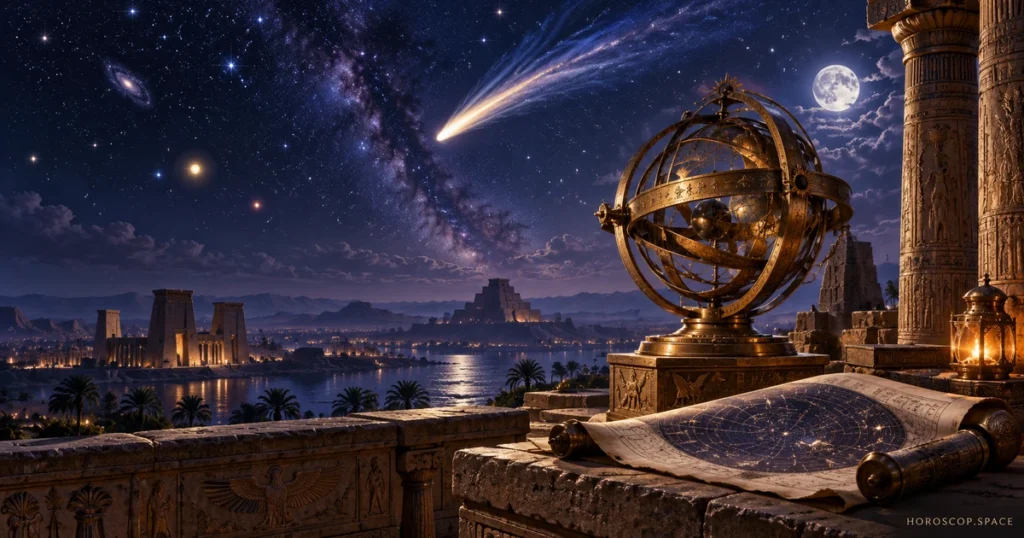
The night sky held extraordinary meaning for people of earlier ages. In the ancient world, people gazed at the firmament to discover the meaning of the stars and of the gods who dwelt among them. Many ancient religions identified deities with stars. It was from this fascination that both astronomy and astrology were born – for thousands of years the two were inseparable.
The star that meant “god”
Some of the oldest known written records come from the Sumerians of southern Mesopotamia, in what is now Iraq. Their script, which grew out of pictorial symbols, contained a sign of special importance: a simple drawing of a star that stood for the word dingir – “god” – and for the name of the sky god, Anu. The idea that heavenly bodies were divine was also well known to the Greeks and Romans. Their sages spent countless hours pondering what the gods were and where they came from. The deities they worshipped personified the forces of nature and traits of human nature, and philosophers often concluded that the original gods were the planets.
Priest-astronomers
Since the heavenly bodies were thought to be divine, people began to study them closely. In many ancient urban civilisations, observation of the sky was carried out by specialist priests according to their own carefully developed systems. From the middle of the second millennium BC, Babylonian priests recorded the movements of Venus and the Moon on clay tablets, trying to predict eclipses.
The Maya of Central America built observatories to satisfy their great interest in the sky. They believed that the heavens reflected – or even brought down to Earth – dramatic events: the births and deaths of rulers and the fall of great powers. Watching the sky made it possible to predict astronomical phenomena, and these in turn were supposed to foretell the course of political events. Small wonder that the life of some great civilisations was so strongly governed by the calendar.
A calendar written in the sky
Calendars were based on the movements of the Sun and Moon and on the risings and settings of stars and planets. A calendar set by the sky was vital for organising life – from festivals to work in the fields. Farmers needed to know when to sow and when to harvest.
Finds from the European Stone Age, more than 20,000 years old, are sometimes regarded as the oldest calendars; researchers suppose that they were used above all to record lunar months. It is hard to believe how long ago people began measuring time by the sky.
Observation of the heavenly bodies was closely bound up with belief, and the astronomers of old were usually priests. This was the era of great megalithic structures such as Stonehenge, aligned with the position of the Sun. There is also a hypothesis that the layout of the great Egyptian pyramids at Giza mirrors the arrangement of the stars in Orion’s Belt.
Meteorites – fragments of the sky
Ancient civilisations watched the sky not only to follow the movements of the planets, but also to look for signs of the gods’ presence. A surprising number of ancient cults venerated meteorites – fragments of the sky that had fallen to Earth. So many accounts of falling meteorites survive from those times that you might think they happened more often than they do today.
Comets as signs of fate
The same was true of comets. In the early years of the Roman Empire, few important political events took place without a comet. The most famous appeared in 44 BC, during the ceremonies in honour of the murdered Julius Caesar – it was taken to be the soul of the great leader rising to heaven. A few decades later, another extraordinary phenomenon in the sky, possibly also a comet, is said by tradition to have led the wise men from the East to the birthplace of Jesus.
During the reign of Nero (AD 54–68) at least four comets were seen, and in AD 66 Halley’s Comet appeared. Many scholars believe that the number 666 in the Book of Revelation is Nero’s name in code, and not – as is often thought today – the mark of Satan.
The surprising knowledge of the Greeks
Modern science explores in many ways just how extensive ancient knowledge of the sky was. The ancients regarded comets as harbingers of disaster, but they also knew that meteorites fall from the sky. The Greeks amassed an enormous body of astronomical knowledge. The Pythagoreans taught that the Earth is a sphere. In the fifth century BC Philolaus claimed that the Earth moves, and at the end of the fourth century BC Heraclides of Pontus described its rotation on its own axis.
Around 280 BC Aristarchus of Samos, one of the greatest astronomers of antiquity, proposed a heliocentric system: the Earth not only rotates on its axis but – like the other planets – orbits the Sun. His idea, however, did not win acceptance. For centuries afterwards the geocentric model prevailed, resting on the authority of Aristotle and Ptolemy and, in the Middle Ages, reinforced by theology. Heliocentrism returned only with Nicolaus Copernicus in the sixteenth century and became widely accepted in the time of Galileo.
Rediscoveries
You could say that many discoveries of the sixteenth and seventeenth centuries repeated ideas from long before. Where did the ancient world draw such vast knowledge of the sky from? In part it was the legacy of earlier cultures – the Babylonians and the Egyptians. Records and calculations gathered over centuries gave ancient mathematicians, philosophers and astrologers a rich body of material to draw on.
First published (Polish original): 30 May 2012. Written by astrologers and esoteric specialists working with our editorial team; edited and translated for HOROSCOP.SPACE. © All rights reserved.