The Moon is both the easiest celestial body to observe and one of astrology’s central symbols. This guide separates the real lunar cycle from its traditional chart interpretation, explains the natal Moon, and shows how to use lunar symbolism without treating it as a forecast.
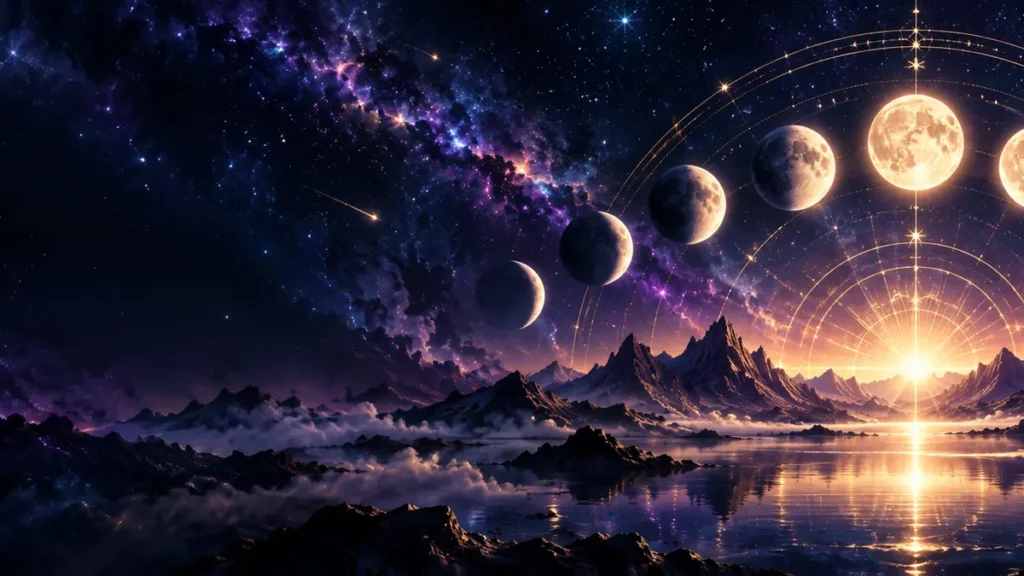
Moon phases: what happens in the sky
Phases arise from the changing angle between the Sun, Earth and Moon: we see different portions of the Moon’s sunlit hemisphere. Over a synodic cycle averaging about 29.5 days, the sequence is new Moon, waxing crescent, first quarter, waxing gibbous, full Moon, waning gibbous, last quarter and waning crescent. This is changing illumination geometry, not a change in the Moon’s physical shape.
New and full Moons mark opposite points in the cycle, with the quarters between them. “Moon phase” can mean one of the eight named stages or simply whether the visible disk is waxing or waning. Astronomers calculate the exact phase; its appearance also depends on when and where it is observed.
The Moon in a natal birth chart
In astrological tradition, the Moon symbolizes emotional responses, habits, memory, security and ways of seeking closeness. Its sign is read as a style of expressing those needs, its house as a life area where they may be noticeable, and its aspects as relationships with other chart functions. This is symbolic language, not a psychological diagnosis.
A Moon sign alone cannot describe a whole personality. Read it alongside the Sun, Ascendant, its sign ruler, house placement and close aspects. Birth time and location affect house calculations; when the time is uncertain, avoid strong claims about the Moon’s house.
Lunar phases and transits as astrological symbols
Symbolic readings often associate the new Moon with beginnings or setting an intention, and the full Moon with culmination, visibility or a meeting of opposites. The waxing and waning light offers a metaphor for developing, reviewing and completing a process. These are interpretive conventions, not verified mechanisms that guarantee events or moods.
The current lunar phase is different from the phase at birth. The transiting Moon changes sign and phase quickly, so astrologers may use it as brief timing context; it should not determine major choices or be blamed for anyone’s behaviour. Any reading needs the full chart and real-world circumstances.
A careful, practical way to read the Moon
Start by asking what you want to understand: the symbolism of emotional needs in a natal chart, or the astronomical phase on a particular date? Then check birth data, sign, house and closest aspects. Treat possible meanings as reflection prompts—such as “What helps me feel settled?”—rather than fixed labels.
Compare an interpretation with lived experience and leave room for other explanations. Do not judge a relationship, health or future from a lunar phase alone. Astrology can offer metaphors for discussing rhythms and feelings, while health, financial and safety decisions should rely on sound evidence and practical needs.
Frequently asked questions
How long is one complete Moon phase cycle?
The synodic cycle, from one new Moon to the next, averages about 29.5 days. Its individual phases are not all the same length.
Does the Moon phase at birth determine personality?
No. Astrology treats it as one symbolic factor to read with the Moon’s sign, house, aspects and the rest of the chart. It is neither a diagnosis nor a scientific explanation of personality.
How to use this guide: Astrology is a historical symbolic and interpretive system; its claims are not a scientific method for diagnosis or prediction. This guide is educational and does not replace professional advice.