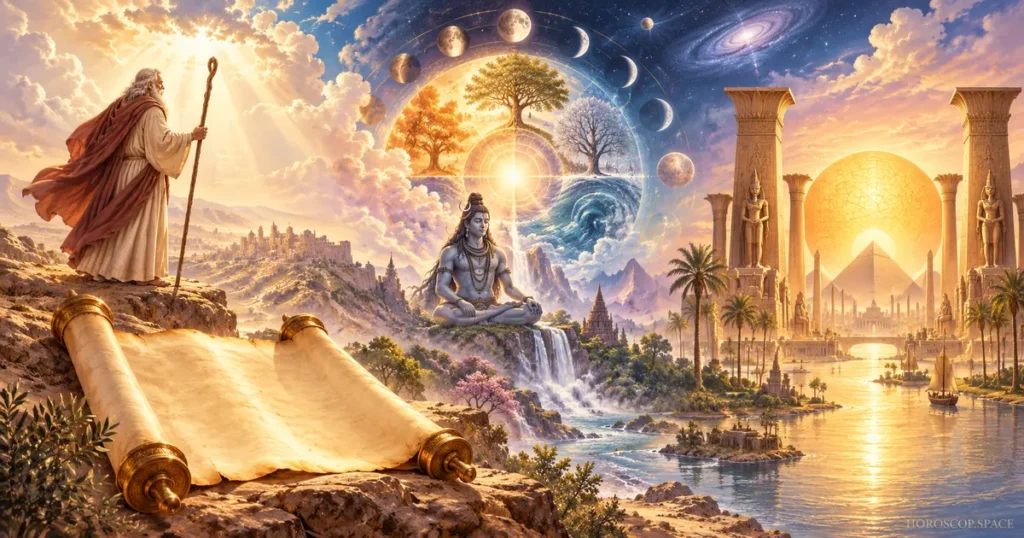
The question of how the world will end has been with humanity for thousands of years. Different religions have answered it in different ways. In the Jewish, Christian and Muslim traditions the history of the world has a beginning and a single, final end. Hinduism sees time as vast, repeating cycles in which the world comes into being and passes away many times. The ancient Egyptians linked the order of the world to the movement of the stars and to the eternal order established by the gods. Below is a brief comparison of how the end of the world is portrayed in the religions of these cultural spheres.
The Apocalypse in the Bible
The most famous biblical description of the end of time is found in the Revelation of St John, the last book of the New Testament, written, according to tradition, at the end of the first century on the Greek island of Patmos. It is a text full of symbols and visions.
Its central motif is a book sealed with seven seals. Opening the first four releases the Four Horsemen of the Apocalypse, usually interpreted as conquest, war, famine and death. When the fifth seal is opened, the martyrs appear; they receive white robes and are told to wait until the others join them. The sixth seal brings a great earthquake, and when the seventh is opened, silence falls in heaven and seven angels with trumpets appear.
The sound of each trumpet heralds further calamities. At the fifth trumpet a star falls from the sky, and out of the abyss come locusts with human faces, golden crowns and lions’ teeth, which harm only those who do not have God’s seal on their foreheads. At the sixth, four angels lead a vast army of horsemen on lion-headed horses breathing fire, smoke and sulphur. The seventh trumpet proclaims that the Lord is taking dominion over the world and will reign for ever.
In Christianity the Apocalypse is associated with awaiting the Second Coming of Christ, the Last Judgement and the final victory of good. Many Christian communities read it primarily symbolically, as a book of hope for the persecuted. The Gospels also stress that the date of the end cannot be calculated: “Take heed, watch: for ye know not when the time is” (Mark 13:33).
The Day of Judgement in Islam
Muslims, too, believe that the Day of Judgement (Yawm al-Qiyamah) will come. According to the Qur’an and tradition, at the sound of a trumpet the mountains and the earth will be crushed, the sky will split open, and all peoples – past and present – will be summoned to judgement. Nothing will remain hidden. Those who receive the book of their deeds in their right hand will go to paradise, and those who receive it in their left – to hell.
Tradition also lists signs preceding the end. They include smoke veiling the sky, the sun rising in the west – after which repentance will no longer be possible – and the appearance of a beast that will speak to people and mark their faces. In some accounts the beast is to emerge from the area of the hill of Safa in Mecca. The day and hour themselves, as Islam stresses, are known to no one but God.
Kali Yuga – the end of an age in Hinduism
In Hinduism time runs in cycles. Each great cycle is divided into four ages – yugas: Satya, Treta, Dvapara and Kali. With each successive age dharma, the cosmic and moral order, grows weaker. According to tradition we are now living in the fourth and last age – the Kali Yuga. Its name should not be confused with that of the goddess Kali; it derives from the worst throw in an ancient game of dice and from the demon who personifies this age. Traditional reckonings say that the Kali Yuga began in 3102 BC and will last 432,000 years.
The Puranic texts describe this age as a time of decline: people will be greedy, focused on material rather than spiritual goods, will live shorter lives and take pleasure in dishonesty. Many false prophets will appear, wealth will be the measure of nobility, and the land will be valued only for its treasures. The rulers will be strong men of bad character. Purification will come through a ritual bath, and the greatest virtue will be charity.
The end of the Kali Yuga, however, does not mean the final end of everything. In Vaishnavism, Vishnu – alongside Brahma and Shiva one of the most important gods – comes into the world again and again to restore order. His last incarnation, Kalki, depicted as a rider on a white horse, is to bring the age of evil to an end and usher in a new golden age. So the world does not perish once and for all – it is reborn in the next cycle. A similar motif of successive worlds is known from Hopi tradition.
Ancient Egypt – the stars and the eternal order
The Egyptians attached enormous importance to observing the sky and regarded this knowledge as sacred. They created one of the oldest solar calendars, dividing the year into twelve months, though they themselves attributed its origin to the gods. The link between the Sun and the seasons was obvious; the phases of the Moon were harder to explain – one myth accounted for the waning Moon by saying that after the full moon it is devoured by a sow.
The Egyptians believed that alongside earthly Egypt there was also a heavenly one, where the souls of the dead dwelt. The dead pharaoh was identified with Osiris, and his soul was to join the stars – the Pyramid Texts speak explicitly of the ruler ascending to the sky, among the gods. The constellation of Orion, associated with Osiris, held a special place.
On this basis Robert Bauval put forward a hypothesis in the 1990s that the three pyramids at Giza mirror the arrangement of the three stars of Orion’s Belt, and the Nile the Milky Way. The date 10,450 BC was linked with this theory. Most Egyptologists regard it sceptically. Popular speculation goes further still, with talk of beings from Orion or Sirius helping to build the pyramids, of “energy systems” hidden in the Great Pyramid, or of the African Dogon people’s knowledge of the star Sirius B. None of this is supported by scientific research; it belongs to the realm of sensational literature.
Egyptian religion did, however, have its own image of the end. In one chapter of the Book of the Dead the god Atum announces that one day he will destroy everything he has created, and the world will return to the primeval waters of chaos from which it emerged. Daily rituals and the order of maat were meant to hold that end at bay by upholding the order of the world.
Common themes
Although these traditions arose in different cultures, several threads link them: the belief that evil and disorder grow before the end of an age, the promise of judgement or purification, and the hope of renewal – in a new world, a new era or the kingdom of God. For believers these are above all stories about the meaning of history and human responsibility, not a calendar of disasters.
First published (Polish original): 24 November 2010. Written by astrologers and esoteric specialists working with our editorial team; edited and translated for HOROSCOP.SPACE. © All rights reserved.