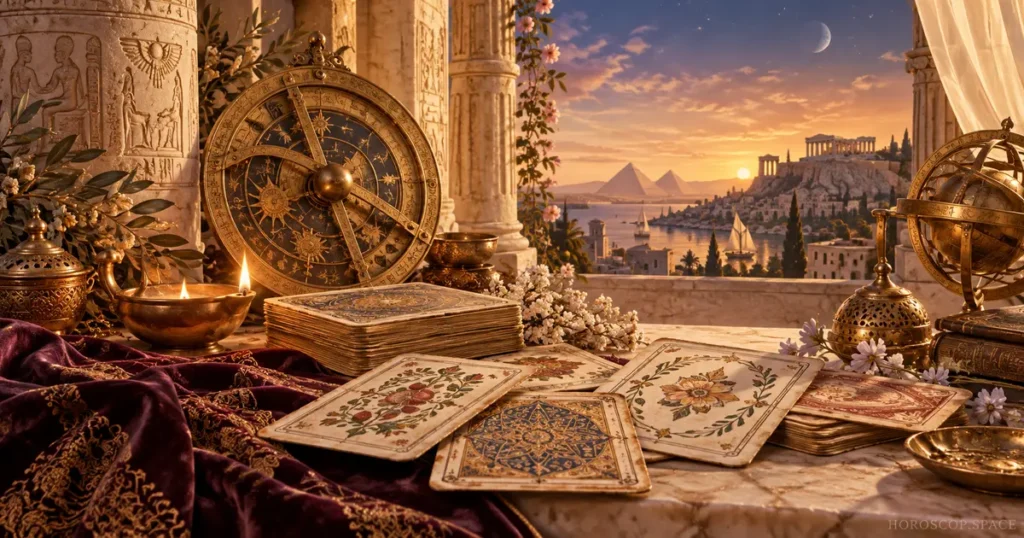
Card reading is one of the most popular methods of foretelling the future. Why should that be?
First, you can take cards with you anywhere. Second, they are cheap, and the art of interpreting them can be learnt relatively quickly. Third, they hold many symbols and signs that speak to the subconscious, which allows intuition to read them. Cards offer a wonderful opportunity to explore the art of divination on your own. Over the last century a great many kinds of divination cards have appeared, created by people who practise cartomancy. Some of them, however, have nothing to do with its tradition.
For centuries the most widely used cards for fortune-telling have remained the classic ones – ordinary playing cards. They are easy to read, and almost anyone can use them.
Over the centuries the art of card reading has followed a complicated and tangled path. Its original purpose often can no longer be recognised. It seems rather that a new, experience-based discipline grew out of a blend of spiritual currents such as astrology, numerology and the Kabbalah. It is built on colourful cards decorated with symbols, and it is offered to anyone searching for the truth.
The art of divination in ancient times
In antiquity divination was among the duties of priests, for instance among the Egyptians and Babylonians. In the fifteenth and sixteenth centuries it spread across Europe, developing alongside astrology and palmistry.
In Poland fortune-telling was practised mostly by the Roma, once called Gypsies – a nomadic people of Indo-European origin who, around the turn of the fourteenth century, migrated from northern India to the Balkan Peninsula and from there spread throughout Europe. When playing cards reached Poland, some Poles too began to use them to tell fortunes and predict the future.
The first decks of cards
The first cards in Europe were made from thin wooden boards, drawn and painted by hand. Later they were printed from woodcuts and usually coloured by hand. The oldest surviving cards date from the fifteenth century and are held in the collections of the National Library of France in Paris.
For a long time the most widespread cards were those made to the German pattern established in the seventeenth century. At the beginning of the twentieth century they began to be displaced by French-suited cards, with finer artwork and a more elegant look. There are of course other kinds of classic cards too – Egyptian, Chinese, Japanese and Indian – but they are little known in Poland.
Today many new decks are also being created, depicting all sorts of symbols, beliefs and cultures, and they have little in common with historical cards.
In the end, though, it does not matter which cards are used for interpretation and foretelling the future. What matters most is how well the reader knows her cards and whether she can use them properly to help another person.
First published (Polish original): 27 May 2012. Written by astrologers and esoteric specialists working with our editorial team; edited and translated for HOROSCOP.SPACE. © All rights reserved.