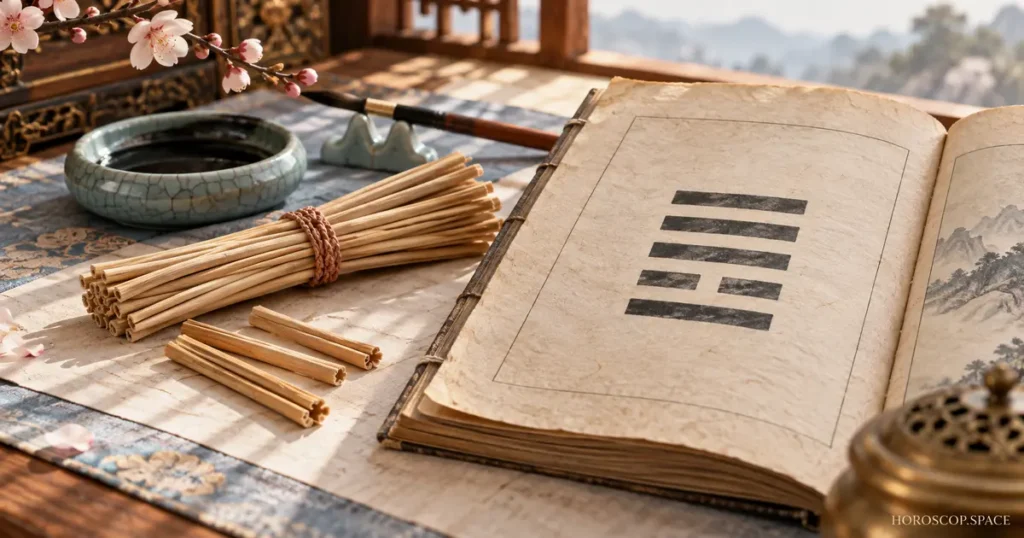
- The Book of Changes – the I Ching
The I Ching is an ancient oracle for exploring life in the broadest sense – both the reality around us and our inner self. In short, you could call it a guide to life. As its name, “the Book of Changes”, suggests, it is based on the fundamental principle of the universe: change. Everything is constantly changing; nothing is permanent. These changes are cyclical and arise from the interplay of two primordial energies, the forces that create the universe: feminine yin and masculine yang.
The structure of the book
The basic element of the Book of Changes is the hexagram, a graphic sign made up of six lines symbolising the forces of yin (a broken line) and yang (an unbroken line). Each hexagram consists of two basic trigrams, a lower and an upper one – graphic signs made up of three lines. The trigrams represent the four elements. Each element is represented by two trigrams, giving 4 × 2 = 8 different trigrams. Since a hexagram combines two trigrams, the number of possible combinations is 8 × 8 = 64 different hexagrams.
How the Book of Changes gives advice
The Book of Changes answers a question with one of its 64 hexagrams, each a symbolic description of a situation. You obtain a hexagram by casting each of its six lines. One method of casting the lines is based on tossing three coins. A single line is cast as follows:
- Toss three coins.
- One side of a coin (e.g. heads) scores 2 points, the other side (tails) scores 3 points.
- Add up the points from all three coins.
- The total determines the line you have cast:
- 6 points – a yin line changing into yang – 7 points – a yang line – 8 points – a yin line – 9 points – a yang line changing into yin
Example
The question put to the oracle is: What is my current situation in life, and where is it heading now?
- Cast the six successive lines of the hexagram.
- The 1st toss gives 6 points – a yin line changing into yang.
- The 2nd toss gives 7 points – a yang line – the 3rd toss gives 9 points – a yang line changing into yin – the 4th toss gives 7 points – a yang line – the 5th toss gives 7 points – a yang line – the 6th toss gives 8 points – a yin line
The hexagram cast is number 28, Preponderance of the Great
The first and third lines of the hexagram change into their opposites.
Interpreting the answer
When should you consult the oracle?
When:
You are hesitating and cannot make a decision about something.
You want to make sure a decision you have made is right, even if at first glance it seems sound.
You want to explore matters hidden from your everyday awareness that are hard to analyse through logical thinking.
What can you ask?
Anything – but you should rather avoid asking what exactly will happen in the future, because everything in the world is constantly changing, the future included. The oracle is best at suggesting what to do or not to do and what attitude to take towards future events; it will not answer a question like “What will happen to me next week?”.
To understand the oracle’s answer properly, you need to know the symbols assigned to each trigram, the strength and position of the hexagram’s lines and the role of the changing lines. Next, examine the nuclear trigrams (formed from the middle lines of the hexagram). The changing lines clarify the details of the situation you are asking about. Once turned into their opposites, they form a second hexagram, showing how matters will develop in the future and the consequences of your present actions or omissions.
Hexagrams:
- The nuclear hexagram symbolises the hidden motives, causes and tendencies within the present situation described by the hexagram you cast.
- The hexagram you cast symbolises the present situation.
- The hexagram formed after the lines change symbolises the most likely, expected changes.
Trigrams:
- The lower and upper nuclear trigrams refine the answer and provide additional advice and associations.
- The symbols associated with the trigrams are sometimes essential for a precise understanding of the reading. You can read them by clicking on the image representing each trigram.
- The lower trigram shows the person’s current situation and its beginning in time – that is, what is only just arriving.
- The upper trigram shows the outer, conditioning situation, its result and its end – that is, what is already passing into the past.
The strength and position of the lines:
- The fourth line plays the role of a minister who must obey his ruler, which is why it is warned of failure and punishment.
- The fifth line is the place of the ruler, so it usually “has merit” and victory belongs to it.
- The pronouncements of the opening lines of the hexagram will come true in the near future, which makes them hard to understand properly as yet.
- The second line describes a servant who carries out his duties properly, which is why he “is praised”.
- The third line closes the lower trigram, so it fails in its actions and “has an unfavourable fate”.
- The sixth line is the third line of the second trigram, so it reaches fulfilment, the end and a state of transformation towards the new; hence, like the third line, it often meets an “unfavourable fate”. It describes a situation already passing into the past.
Sample questions for your oracle – What is my current situation in life, and where is it heading?
- What can I (and should I) do in this situation?
- How will my affairs unfold (where are they heading)?
- Do my plans have a chance of success in this situation?
How should I act, and what attitude should I take, in this situation in life?
How should you behave while your oracle is giving advice?
· While the oracle is giving advice – that is, while the hexagram is being cast – both the reader and the person seeking advice should concentrate on the question being asked. When your thoughts are elsewhere, or when you treat it as a game, the answer naturally cannot be true. Of course, nobody forbids you to approach the oracle playfully – but then you must be prepared for a playful answer.
- “The Book of Changes”, German translation by Richard Wilhelm, Polish translation by Wojciech Jozwiak and Krzysztof Ostas;
- “Ksiega wrozb” (The Book of Divination), Tadeusz Zysk, Jacek Kryg.
First published (Polish original): 19 February 2009. Written by astrologers and esoteric specialists working with our editorial team; edited and translated for HOROSCOP.SPACE. © All rights reserved.