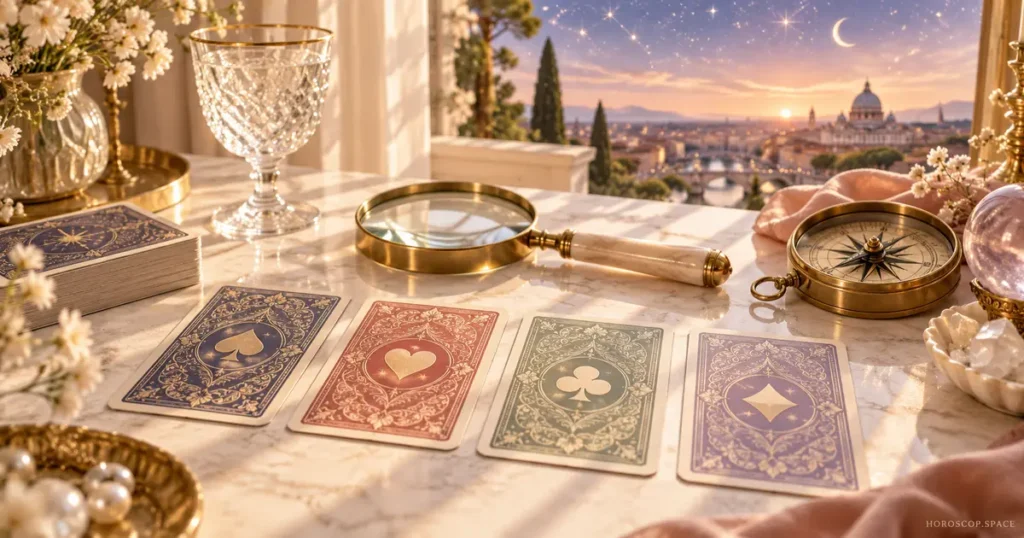
The art of reading classic playing cards rests on the ability to foresee in general – the cards merely make it easier. Even so, card reading is not as simple as it might seem at first glance. What matters most is interpretation, meaning the way the reader links the cards together. Card readings, like all metaphysical enquiries, rest on the principle of probability. No prediction, however carefully made, is one hundred per cent certain to come true. You always have to allow for unknowns and chance factors that may ultimately change the assumptions and forecasts.
Reading classic playing cards
That is why a reading should not be taken literally but as a pointer and the most likely scenario, which may or may not unfold in your life.
There are as many theories about the origin of playing cards as there are ways of interpreting their meaning.
When cards began to appear at the courts of European monarchs, and in time among ordinary people as well, the Catholic Church saw them as a threat, which led to bans on their use. Classic cards served both for foretelling the future and – increasingly – for gambling. By the nineteenth century card reading was widespread and very popular.
Part of the convenience of card reading is that almost every home has a deck that can be used for a reading.
The deck and divination systems
A full deck of classic cards has 52 cards, but readings most often use 32 or 24. There are many divination systems, ways of laying out the cards and methods of reading them. Everything depends on which method a novice reader chooses. Sometimes the differences in interpretation are so great that one reader would not understand another’s reading. That, however, is a personal matter for each person who reads the cards.
There are also many versions of classic cards, depending on the country where they were made. In the old days Poland used mainly the German version, and later the French one.
The role of the reader
A sensitive fortune-teller, woman or man, will help to shed light on problems and let the person asking make their own decisions about the future. The reader’s skill lies in interpreting individual cards and their combinations in a way that is helpful and useful to the questioner. A good reader also has empathy for people, which allows her to pick up the feelings that support her interpretation.
What complicates matters is that people prefer to hear good news about their future. Although they say they are ready to accept both bad news and good, deep down they want to hear only the good. The cards become a bridge between the questioner and the reader. They reach deep into the superconscious – a person’s intuition – and into the intuition of the universe. Thanks to this, as those who practise cartomancy believe, the most likely events can be foreseen.
Today there are hundreds of different divination decks on the Polish and world markets, as well as Polish versions of cards devised by local fortune-tellers. Many practitioners, however, return to the ordinary deck of playing cards – simple, easy to come by and tested by generations.
First published (Polish original): 27 May 2012. Written by astrologers and esoteric specialists working with our editorial team; edited and translated for HOROSCOP.SPACE. © All rights reserved.