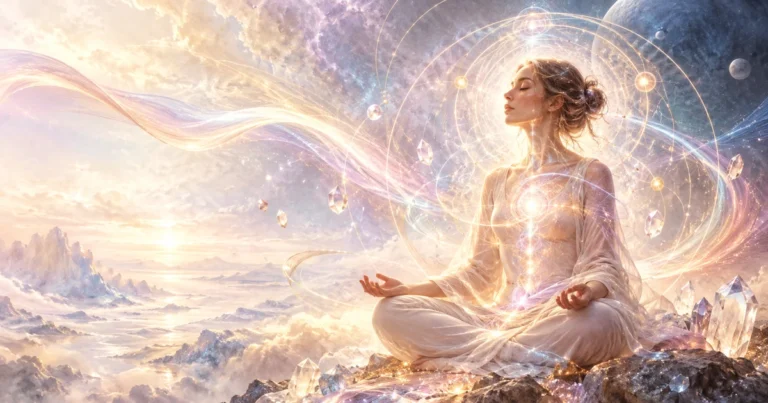
Destiny means fate, lot, fatum, predestination – that which has been foretold, an irrevocable necessity.
It is the idea that a person’s fate is determined in advance. That is why people constantly try to learn the future – through fortune telling, astrology, clairvoyance or prophecy – and then to change it.
People have always searched for signs they could connect with their future. They created ever more complex systems and extended them into both the future and the past. In this way they built beliefs and myths that gave them the impetus for their daily efforts to improve their lot. Yet their greatest difficulty was always solving their own everyday problems – their personal struggles with a surrounding world that seemed impossible to overcome. These struggles concerned above all the realm of feelings and inner experience, of beliefs, and of the accumulated experiences their destiny had prepared for them. There are moments in everyone’s life when we ask ourselves whether our existence so far, or some sudden event, was the intervention of a Higher Being or blind chance.
. At such moments, many strange questions arise. How can you discover your destiny? Does destiny exist at all? Do we have completely free will? What is our personal responsibility for our own lives? I have found at least part of the answer to these questions. Something like destiny does exist, and we reach it by different paths – yet not everything is written somewhere up above. Free will exists too: we act as we choose and then await the consequences of our actions. Glimpsing the future through card readings gives us the chance to change the direction of our path, which is why omens and predictions of every kind have such a strong influence on us. I have spent many years reading classic playing cards and the tarot; I have helped many people and friends and given them valuable guidance, and much of what the cards tell me comes true. But we must remember that with every choice and every decision we can change a great deal in our lives. By revealing future events to the reader, the cards give us the chance to change the ones we do not want. What is destiny? We have been asking ourselves this question, in one form or another, since the beginning of time. Today it is described as fatum, predestination, that which has been foretold.
It is the idea that a person’s fate has already been written in advance. That is why we try to learn something about the future and our destiny by consulting fortune tellers, clairvoyants and astrologers.
The problem, however, is that many people who visit a fortune teller to learn their future do not realise that we have our own will and can make our own decisions. Fortune tellers and esoterically gifted people know this: all they can show us are the various paths we might choose, and the one that is most likely at this moment. We confuse ideas when we assume our life is set in stone. It is we, as thinking people, who make conscious or unconscious choices about our path in life. Predictions can bring the energy of the future closer to you, but in the end it is you who decides your way. Thanks to the guidance of fortune tellers, seers and clairvoyants, we can change our future a little if a problem shows up in it, and avoid many unpleasant events. A visit to a fortune teller should enrich you and open your eyes to reality. Each of us has moments in life when we wonder what it is all about. Why do we exist? Why is our life going in this direction and not another? What is our responsibility for our life? Is someone guiding us? There are many theories. Some say that only we ourselves shape our lives. Others say that we are born with our destiny more or less chosen, and spend our whole lives unconsciously making our way towards it. For many of us, having our future foretold should be an adventure and a chance to discover hidden parts of our own “self”. No prediction is an oracle – it is only a possible path. That is why people’s view of prophecy is so often mistaken, and perhaps why fortune tellers and people with such gifts are not taken seriously.
- Hinduism – belief. As long as sanchita karma continues to accumulate, part of it will turn into prarabdha karma, which is used up, while part will remain, leading to further births and deaths. Every kriyamana karma becomes sanchita karma once the action has been performed. A being (Sanskrit: jiva), or more precisely the reincarnating soul (Sanskrit: atman), cannot attain liberation (Sanskrit: moksha) until the accumulated sanchita karma has been completely exhausted. According to some Hindu denominations karma may be closely tied to the figure of God, while according to others it is more independent. Followers of Vedanta believe that Ishvara, the supreme God, plays a certain role in dispensing karma. Theistic schools of Hinduism such as Vedanta disagree with the view of the Buddhists and Jains. Other Hindu schools hold that karma is simply the law of cause and effect, though it also depends on the will of the supreme God. Of the accumulated sanchita karma, only a handful serves any one lifetime, and the actions that bear fruit and are then exhausted are called prarabdha karma. Examples of supreme deities here are Shiva in Shaivism and Vishnu in Vaishnavism. These theistic views are well summed up in the following verse: God does not make anyone suffer without reason, nor does He make anyone happy without cause. God is just and gives you what you deserve.
Hindu scriptures distinguish three kinds of karma
Kriyamana (present). Sanchita (accumulated).
Prarabdha (bearing fruit)
Those excluded from the system of orthodox Hinduism – for example as a result of neglecting the religious and social duties arising from varna and jati – are seen as beings not subject to the law of karma, that is, as lacking the potential to be reincarnated in another body after death. Buddhism
Ignorance here means an innate lack of knowledge of the truth: for example, of the Four Noble Truths, the Noble Eightfold Path or the Three Marks of Existence. Karma is a fundamental and very important concept in all schools of Buddhism, and here it means simply “intentional action”. It does not, therefore, mean the result (called the fruit), the effect or destiny. The law of cause and effect is called kamma-vipaka (action and fruit) in Pali. In Buddhism it is a universal and impersonal law.
What determines the moral value of any action is the will or intention behind it. Will with unwholesome roots – craving (or greed), anger and ignorance – bears harmful fruit. Will joined with wholesome roots – the absence of craving (that is, renunciation), the absence of anger (that is, loving kindness) and wisdom – bears beneficial fruit.
The ten kinds of unwholesome action (Pali: kamma-patha) are: three bad actions of the body – killing, stealing and sexual misconduct; four bad actions of speech – lying, slander, harsh speech and idle chatter; and three bad actions of the mind – covetousness, anger and wrong views.
The law of karma rules out the existence of a first cause. According to Buddhist teaching, the chain of cause and effect has always existed. According to the theory of Dependent Origination, the original cause of the cycle of existence, samsara, is ignorance. Craving and ignorance are the particular causes of karma and lead to both unhappy and happy destinies.
Destiny means fate, lot, fatum, predestination – that which has been foretold, an irrevocable necessity.
It is the idea that a person’s fate is determined in advance. That is why people constantly try to learn the future – through fortune telling, astrology, clairvoyance or prophecy – and then to change it.
There are moments in everyone’s life when we ask ourselves whether our existence so far, or some sudden event, was the intervention of a Higher Being or blind chance.
. At such moments, many strange questions arise. How can you discover your destiny? Does destiny exist at all? Do we have completely free will? What is our personal responsibility for our own lives? I have found at least part of the answer to these questions. Something like destiny does exist, and we reach it by different paths – yet not everything is written somewhere up above. Free will exists too: we act as we choose and then await the consequences of our actions. Glimpsing the future through card readings gives us the chance to change the direction of our path, which is why omens and predictions of every kind have such a strong influence on us. I have spent many years reading classic playing cards and the tarot; I have helped many people and friends and given them valuable guidance, and much of what the cards tell me comes true. But we must remember that with every choice and every decision we can change a great deal in our lives. By revealing future events to the reader, the cards give us the chance to change the ones we do not want.
- “And God reveals the future only very rarely – and only when it has been written in order to be changed.” (P. Coelho)
- “Strange is our situation here on Earth. Each of us comes for a short visit, not knowing why, yet sometimes seeming to divine a purpose.”
(A. Einstein)
- “Destiny is usually waiting just around the corner, like a pickpocket, a hooker or a lottery-ticket seller: those are its most common incarnations.
- It never knocks at the door of your home. You have to go after it.” (Carlos Ruiz Zafon)
Fatum – in Greek mythology, the personification of inevitable, irreversible fate: the irrevocable will of the gods, which no one can influence. The fatum hanging over a hero limited the scope of his free will, steering the consequences of his actions in one single, ruinous direction. It was the direct cause of his final downfall and tragedy. In everyday speech it simply means destiny – with the difference that destiny can also have a positive ring, and is then personified by Tyche (or by Fortuna, better known from Roman mythology).
Part 1
Have you ever wondered what personalities such as Bill Clinton, J.F. Kennedy or Sting have in common?
All of them were able to push themselves again and again into effective action leading to the success they dreamed of. But what is it that makes them get up every day with faith in the day ahead, and act?
There are many such factors. Anthony Robbins, the world-renowned motivational speaker and adviser to many political leaders, presents seven basic qualities – mechanisms that release the will to act – which can also help you succeed.
- PASSION!
All the people I have mentioned had a well-considered goal that absorbed them completely – one that drove them to act, to grow, to become something more. It is passion that makes scientists devote years of work to an invention. Passion is the engine that drives our psyche, and it is passion that people need in their relationships with one another.
- BELIEF!
Our beliefs about who we are and who we can be closely determine who we will become. If we are convinced that our life fits within narrow limits, those limits really will become narrow and real. Whatever we accept as possible and true becomes so. This series of articles will teach you how to change your habits and thought patterns so that you live better and achieve success, both small and great.
- STRATEGY!
Strategy is nothing more than a way of organising your resources. Anyone who has achieved something in life knows that passion and belief are not enough to succeed: you need a strategy, some kind of plan. You have to use your resources in the most effective way. Strategy means realising that even the greatest talents and ambitions have to be put to proper use.
- Clearly defined values!
Ideas such as patriotism, pride and freedom are ethical and moral values: they shape our judgements and define what is important or less important to us, what is good or bad. Some people do not have clear views. We often do things that make us unhappy because, at that moment, we are not aware of what is good or bad for us – only with time do we notice emotional discomfort and dissatisfaction in our lives. We need a sense of what is important to us and what matters most. The more strongly we believe in something, the more we are willing to invest in achieving it. If your new strategy demands behaviour or beliefs that are not consistent with who you are – that contradict your personality – then even the best-planned strategy will not help. There must be no inner conflict.
- ENERGY!
Outstanding people take opportunities into their own hands. They don’t grumble, sit in a chair and complain about how hard things are – they simply act. They live as though a new opportunity, a new and better possibility, might come along any day. There are many people who approach what they believe in with passion.
- The ability to make connections!
This is an essential skill that has to be developed if you want to succeed. People who achieve something entirely alone are rare – perhaps the only ones are certain scientists who succeed in one field and fail in others because they cannot communicate with those around them.
- Masterful communication
The way we communicate ultimately completes the quality of our lives. Those who fail accept adversity and treat it as a limitation.
In the next articles I will present ways to take control of yourself and to activate your mind and body so that they work more effectively.
The meaning of life should be understood as an inseparable relationship: the striving towards a definitively defined purpose of a person’s existence, together with the possibility of reaching it in line with one’s own views.
We often begin to think about the meaning of our existence only in the face of approaching death. We sense that life has meaning, but we do not consider it intellectually. The meaning of life is something hidden, something inner. Our understanding of the word “meaning” is very close to the idea of “purposelessness”. We can understand meaning as gain or benefit – yet we think about the meaning of life only once we have lost it.
An existential crisis (a crisis of the human being) is not an intellectual discovery; rather, a person begins to realise that something is missing from their life, something they do not have. Such a person starts thinking about the meaning of life while in a state of existential anxiety. Existential anxiety is pain – anxiety about human existence itself. Paul Tillich distinguishes two levels of existential anxiety, absolute and relative, as well as different functions of this feeling.
-
Anxiety about one’s fate and death operates on the relative level: it threatens us, but there are ways to prevent it. Anxiety and fear of death itself define the absolute level. Powerlessness paralyses a person and creates a feeling of emptiness.
-
This is the anxiety of emptiness and meaninglessness. On the relative level it is possible to try to forget and enjoy life, but on the absolute level nothing more can be done.
-
The anxiety of condemnation and guilt. Condemnation exists on the absolute level; on the relative level there is anxiety.
The psychiatrist Viktor Frankl, who introduced the concept of noogenic neurosis, researched the meaning of life.
Having a sense of meaning in life is a necessary condition for a person’s development and self-realisation. Bringing this problem into psychology has contributed to a better understanding of the causes of suicide.
Different kinds of anxiety exist at different times and in different parts of the human psyche. People feel that life is meaningless and often want to take their own lives. Viktor Frankl distinguishes three main drives: the drive to express one’s sexuality (and more), the drive for power, and the drive to achieve goals. At different times and in different situations a person chooses one of them, and then tries the others.
Such a person works very hard, has a definite goal and tries to reach it. Even so, what follows is the so-called “depression of victory”: the person achieves the goal, but their enthusiasm fades and they are left with a sense of existential emptiness and confusion.
Most people set the direction and purpose of their lives themselves, supported by their beliefs, convictions and knowledge.
by Misty Peterson
“And God reveals the future only very rarely – and only when it has been written in order to be changed.” (P. Coelho)
“Strange is our situation here on Earth. Each of us comes for a short visit, not knowing why, yet sometimes seeming to divine a purpose.”
(A. Einstein)
“Destiny is usually waiting just around the corner, like a pickpocket, a hooker or a lottery-ticket seller: those are its most common incarnations.
It never knocks at the door of your home. You have to go after it.” (Carlos Ruiz Zafon)
Fatum – in Greek mythology, the personification of inevitable, irreversible fate: the irrevocable will of the gods, which no one can influence. The fatum hanging over a hero limited the scope of his free will, steering the consequences of his actions in one single, ruinous direction. It was the direct cause of his final downfall and tragedy. In everyday speech it simply means destiny – with the difference that destiny can also have a positive ring, and is then personified by Tyche (or by Fortuna, better known from Roman mythology).